Feminism

Feminism

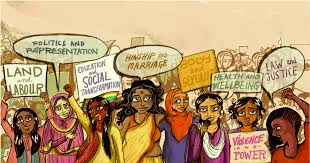
                                        picture: Women with raised hands image coutesy: EPW Feminism is the radical notion that women are...

Showing posts with label Feminism. Show all posts

Friday, 22 December 2017

Violence Against Women in India- some thoughts.

                        
"The rapist is you!" Even as the chants of the flash mob in the video since gone viral, from Chile had a spill over effect, with many similar protests being organised and electrifying viewers the world over, we in India continued to see more and more cases of gender based violence fill up our front pages and airwaves. 

"One is not born, but rather becomes, a woman." 

Gender based violence is often a result of gender based inequalities, and the need for men to conform to the norms of masculinity. 

The power relationships that exist within the contemporary gender landscape are hugely tilted in favour of men. Dominant ideals of manhood impact women and different ways of being men, as also those who fit neither category. 

Historically, the male gender is naturalized as the universal. 

Masculinity is the socially produced and embodied way of being male. It manifests itself in many ways such as manner of speech, behavior, gestures, social interactions, a division of tasks and a position of superiority to its perceived antithesis, femininity. Because masculinity is valorized, its consequences are many and varied not just for women but also those men who do not perform the dominant model of masculinity.

In order to stand in a relationship of superiority to the feminine, masculinity must be represented as the binary opposite of the feminine identity. Dominant masculinity has certain identifying characteristics. Embedded in these representations are an inventory of behaviors and roles that have been historically valorized as becoming of ideal masculinity. Discourses on sexual orientation i.e. heteronormativity, class, race and conjugality all lead to the manufacture of this dominant masculine identity. 

Gender is produced historically and socially. Indeed the discourses around the production of the proper masculine behavior stem from the fact that masculinity is not naturally endowed. Masculinity must be constantly reinforced, hence, it's tenuous and fragile nature. Masculinity is enacted rather than expressed, as it is not something already inherently present. 


PATRIARCHY
Patriarchy is the systemic relationship between men and women, placing men in a s superior position.  It privileges all men. Masculinity produces superior men who are privileged over all women and lesser men. While there are strong cultural expectations that women will be chaste and obedient, no such expectations attach to men. Such a mentality and practices that stem from it result in oppression and exploitation of women. Women themselves tolerate and rationalize this subjugation and see it as natural
In a most recent survey published by India Spend, a web based ortal while 65%Indian women are literate, only 5% have sole control over choosing their partner and 60% practice some or other form of fcae veiling or head covering. 

CASTE IN INDIA
We have to confront the fact that caste is another axis of oppression which women of "lower" castes face the brunt of every day. In fact it comes as no surprise that the majority of the violence that women face in India, are along caste lines. 

Bhanwari Devi, a Dalit woman was raped by upper caste men of her village for simply doing her job, advocating against child marriage. Rape was used a s a tool to "show her her place" and subjugate her. However she continued to fight for justice and it was her struggle that lead to the very first guidelines was formulated to help prevent sexual harrassment faced by women in their workplace.  
          
LAW
The law perpetuates gender hierarchy. It is tasked with the protection of women and this is manifested in paternalism as a form of safety. 

Right to property plays a crucial role in power imbalances within households. Devaluation of daughters as they are not entitled to land or other property leads to the difference in treatment of girls and boys from childhood. Women internalize these limiting characteristics, this lessening of their rights to everything from space, to education to nutrition and even medical care.  

THE VIOLENCE OF THE DENIAL OF LIFE 

The adverse sex ratio of females to males in India is a case in point. Recently the women and child welfare minister said that about 2000 girls are killed in India everyday. A girl is only seen as a burden. As her basic duty in life is to be a housewife and care giver and producer of babies, parents see her as a burden to carry till such time as she can be married off. The dowry that needs to be given as compensation to the man and his family poses further economic burden on the girl's family. 

OBJECTIFICATION


"Man is defined as a human being and a woman as a female — whenever she behaves as a human being she is said to imitate the male."
— Simone de Beauvoir
The body of a man makes sense in itself quite apart from that of women, whereas the latter seems wanting in significance by itself. She appears in essence to the male as a sexual being. Othering of woman is centuries old, and with mothering comes treatment of being sub human. With the institutionalizations of the other, woman cannot be equal. 
Martha Nussbaum has identified the seven different ways in which objectification works:
  • instrumentality
  • denial of autonomy
  • inertness
  • fungibility
  • violability
  • denial of subjectivity.
COMMODIFICATION 

“The body is the instrument of our hold on the world.”

― Simone de BeauvoirThe Second Sex.

The body as our instrument in the world is completely available to men. Boys are encouraged to explore the world, step out into it and have far greater control over their bodies. Women have little control specially in a hierarchical society like India. Girls are indoctrinated into thinking of themselves as less and they also self - identify in a sexualized way, so they may mould themselves into an version appealing to men. 

The ease of commodification of women has increased with globalization. Easy access to TV and phones which help sell women and their sexuality in various ways. There were recent reports that men would rape women and film the act. These videos would then be easily available fir as little as 50 rupees in the market. Easy dissemination of such videos via multimedia messaging has made access to such images of the commodification of women and their bodies.  

The personal and intellectual capacities of women are denied, and the woman spoken of as a body only, or even just a body part. In prostitution no woman stays whole, and certainly not human. The dehumanization and dismemberment of the female body is necessary in prostitution. Pornography is media and image based prostitution where again women's bodies are commodified. Sexualization and commodification are two sides of the same coin. 

THE BEAUTY INDUSTRY

This is yet another product of the sexualization of women's bodies driven by large multinational corporates and advertising conglomerates which form the nexus which drive the huge beauty industry, comprising of cosmetics and body image changing such as cosmetic surgery and of course fashion and garment industries. The time when we would clothe ourselves for protection are far behind us. 

POWER
The meaning of being a man or woman and notions of manhood and womanhood may vary but masculine identity is usually associated with experiences and assertion of power. Paternalistic cultural models encourage the view that men protect women from harm, thus giving the impression that women are incapable of protecting themselves.

SEXUAL VIOLENCE 
Incidents of sexual violence involve elements of control, power, domination, and humiliation. In order to gain power and control over their victims, perpetrators of sexual violence resort to practices such as abduction, isolation, manipulation, coercion, threats, and sexual abuse. 

While men may not necessarily find the act sexually gratifying but the sense of power may override other considerations. If a woman resists sex, it may be perceived as a threat to a man's masculinity. Such a crisis of male identity may contribute to sexual violence. It has been reported that victims who attempt resistance or escape from the situation are more likely to be brutalized by the offender, giving an inflated sense of power to the abuser.
In patriarchal cultures, any resistance from the woman is perceived as an insult to his manhood further provoking him to resort to more violent means to control the victim.

Rape is seen as a tool of a dominance. Societal attitudes toward women may help condone rape. Such stereotypes are often internalized from the male dominated culture at large. 

Sexual violence results from a misogynist attitude prevalent in our culture. Indian girls and women have no independent control of their sexuality. They are expected to get married and produce children, thus shifting the control of their sexuality from one man to the other. 

Till the burden of being sub-humans carries on, no woman will be free from violence. 


Sunday, 20 November 2016

The Women Whom Mainstream Feminism Forgot


Suddenly, the Indian media has discovered "working women".  There's a deluge of articles in the print media, TV shows,  and an explosion of social media handles and entities centering the "working woman". Most of this discourse is focused on the "empowerment" of working women. You'd be forgiven if you thought we'd been intentionally hiding all this time!

However, look a bit more closely, and you would discover that this definition of "working women" is largely confined to a certain category of : those working in offices or corporations, in well paying jobs. 

This should surprise nobody. Women with money of their own, and cash to spare, are now a big part of the consumer segment. It therefore makes sense for any business to focus on them - and the media is most certainly one! And middle and upper class feminists are lapping up this attention.

Don't get me wrong. Gender inequalities dog women every step of the way, and the higher up the ladder a woman travels, the tougher it gets for her. Sample these stats from a Catalyst report
1. Women earn 65% of what their male colleagues earn for the same work. 
2. The more educated a woman is, the wider the gender pay gap.
3. The gender pay gap increases as women advance in their careers.

Most businesses now employ a fair number of women. And the women who succeed in these fields, often work the buddy system system, just as men do. They come from families of privilege and they know how to leverage contacts.

But look closer. The victories that these women forge, are propped up on emotional and care work being performed on their behalf, by other, less paid women. 

Behind every successful man, so goes the adage, there's a woman,  usually his wife-cum-housekeeper-cum-baby-producer. Women continue to do more housework than men by overwhelming numbers. 

But with more women working outside the home in paid jobs, behind every successful woman there's a housekeeper, a maid, a cook. In all probability,  poorly paid and badly treated as Nivedita Menon writes. 

In the most important bastion of female subjugation, the home, the woman continues to slog away, marginalized. We've simply elevated one set of women and replaced it by another, less advantaged one. Yet, we lament endlessly about the lack of labour participation of women. This discourse cuts out working class women who don't belong to the upper or middle class. 

When the motivation is solely profit, humans are the first casualty.  Patriarchy has kept women tied to home and to caregiving work, yet this labour is not factored into wages. When called in to work, women are paid less, their work is deemed less valuable, then they are blamed for lowering wages. Capitalism and patriarchy work in tandem. 

All emotional work and a lot of care work is unpaid. Women continue to perform this labour unappreciated.
Close to two thirds of adult women  in India while away their most productive years engaged only in housework- uncounted, unpaid. 

Let's look at some other numbers. As more than 67% of all rural Indian households depend on firewood for cooking, every year Indian women spend 374 hours collecting firewood

Even as men flock to cities in search of better livelihoods, women left behind turn to the fields for sustenance. The number of women in agriculture has steadily increased, yet more of them are now labourers, tending to the lands of others with no land to their own names.

What is work? Economists say, only that which can contribute monetarily to the economy, can be counted in the GDP as work. When women stay home to raise babies it's decried as a loss to the GDP but nobody asks, without new members to add to the workforce, without children, where would your GDP be? Yet childcare continues to be devalued. 

The labour of women- productive and reproductive continues to run our families, our society and indeed our whole nation. Women keep the wheels of our national economy running. Feminism aims to improve the lot of all women, more so the marginalized, those away from the mainstream. We are nowhere near achieving that. 

And we are not even talking about these women in our public discourse. We mainstream feminists have left these working class women out in the cold. 
The light bouncing off the glass ceiling has left us so awestruck that it's been distracting us from looking at the women at the bottom of the pile, under the ladder. The real work of working towards a more humane and just society for all women hasn't even begun. 

Thursday, 3 November 2016

Movie Review : Ae Dil Hai Mushkil Sehna Ise


How many times have you watched a movie or read a novel, where a sexy woman is out to "trap" a rich guy? Yes, there exist women who seduce men for money. "Seduce" as in "to cause someone to do something that they would not usually consider doing by being very attractive and difficult to refuse" Let me remind you, confused or not, it's a choice they made!

In Ae Dil Hai Mushkil that choice is made by Ayan, Ranbir Kapoor's character. He finds Lisa played by Lisa Haydon incredibly sexy and is repeatedly shown unable to keep it in his pants. Men can't help indulging in sex at the first sight of a female body, you know! Yet, the fault lies squarely at the door of the woman! 

No, I refuse to use the misleading, sexist expression "femme fatale". It's been used too long to demonize women. It's time we discarded it.  Although the sex is consensual, Lisa is portrayed as vacuous and practically unable to speak. Yet there are allusions to how she's out to get Ayan's money. Now now, Karan Johar, you really need to make up your mind- is she stupid, or is she smart? 

Ayan has no compunctions in kissing and coming on to Alizeh, played by Anushka Sharma. This, the first time he meets her. Obviously, loyalty is not a value he sets great store by. Yet, one act of unfaithfulness by his girlfriend and he dumps her. What was that about sauce for the goose thingy? Forget it! 

Let's be clear, this is the umpteenth movie in which Ranbir Kapoor plays a guy coming of age, and the characters are so cliched you'll be deluged with repeated bouts of deja vu. To confound matters further, Karan Johar is yet to sort out his friendship-versus-love dynamics. Dude, it's 2016. For god's sake, you've done this for twenty-odd years now. Get over it!

Besides, a selfish man-child who refuses to grow up and throws tantrums at the drop of a hat, Ayan expects others to pick up after him. That's our hero, the man you're supposed to root for! Not only does he insist Alizeh fall in love with him, he chases her all around the globe in the effort. She invites him for her wedding and he manages to become the centre of attention there, too! He throws a hissy fit and walks out on the wedding day, making it a memorable day for the bride, indeed! This being Bollywood, however, all is forgiven. Conveniently for Ayan, yet again, Alizeh steps in to pick up after him.

The worst is yet to come, however. Ayan shows his most despicable side when he finds Alizeh struggling alone, dying, and comes on to her! Yes, dear readers, sexual harassment and stalking as love trope is alive and thriving in Bollywood.  

The very frame in which we are introduced to Saba, Aishwarya's character, would have set a million alarm bells ringing for any woman. She's sitting by herself reading a book. Our hero forces himself into her space because he can't sit alone! Where any woman would have called security, Saba smilingly indulges him. Men feel entitled to women's space, time and attention. Men often end violently and horrifically the denial of such attention. This is rape culture and the movie promotes it. 

To attempt to look for feminism in a Karan Johar film is futile, when it doesn't even pass the Bechdel Test. It is peopled with super rich people whose lives run without a hitch. They need not worry where the meals or housing or the education of the next few generations will come from.

You see, I left out Alizeh's character till the end. There really isn't one. We know nothing of who she is, what she does. We vaguely hear of parents, but don't meet hem either. She doesn't seem to have any friends either. Alizeh is another in a long line of women who seem to exist solely for the benefit of the men around her. She also shelves her life to trot all around the globe, wherever her husband's work takes him. Need we tell you, that relationship was doomed from the start? 

Anushka Sharma has put in her considerable acting skills on display, and she comes across as effortless. But I'll repeat my earlier advise to her- make your own goddam movies, Anushka! We want to see well-etched characters, not a sidekick for our hero to hang his emotional towel on, and maybe wipe with. 

Aishwarya looks still, unruffled, and bereft of emotion like a slab of marble just surfaced from under a glacier. She too seems to exist in a vacuum. Although she's portrayed as a no-nonsense person at first, yet she too ends up picking up after Ayan. Such a charmer our boy is. 

Women's work holds up men's world. It's time we gave it a rest.


Tuesday, 4 October 2016

Movie Review : Parched, Of Women Thirsting For More

In a lovely sequence in the movie, Parched, two of its four main characters, comfort each other. Rani, played by Tannishtha Chatterjee (wow! what a powerhouse performance!) applies a soothing lotion to Lajjo's (played by Radhika Apte) wounds. Lajjo has once again been beaten by her drunkard husband.A range of  emotions flit across the women's gently-lit faces as they explore each others' injuries. In a sense, this scene is at the heart the movie:  it's a chronicle of women's attempts to make sense of their scars, while exploring their sexualities, and trying to meet the world head on.

The two other protagonists are Bijli, played by Surveen Chawla and  Lehar Khan who plays Janaki. While Rani, Lajjo and Bijli are friends, Janaki is Rani's daughter-in-law, a child bride. In a heart wrenching scene, just after Janaki has been raped by her husband, Rani rebukes her for sleeping late, throwing the usual taunts of 'didn't your mother teach you anything?" As the child limps towards the bath area my heart all but leapt out of my chest. Rani is as much a product of the society she lives in and mistreats her daughter-in-law the same way she was treated when she herself had been a child bride.

Later, in a poignant monologue to her mother-in-law Rani narrates her life events, most of it a tragic unfolding of events beyond her control. She states quite matter of factly, that despite assurances of an improvement in their situation, nothing does.

Bijli, the hard-as-nails sex worker, is saved from looking stereotyped only by Surveen's impressive performance. Though she may appear bindaas and carefree, she longs for a "regular" life. Despite the fact that she sets the terms of sale of her body, she is unable to stop violence and abuse. I'm yet to see on the Indian screen a sex worker with true agency. The portrayal seemed problematic to me for a movie so progressive at heart.  

In one of the heart-gooey-making sub plots the women of the village band together to successfully get a satellite TV dish  installed, despite opposition from the men. The other interesting sub plot is the love story of Kishan, a local guy and Naobi, a Manipuri woman. Kishan is also Lajjo and Rani's employer. Their marriage causes much consternation among the menfolk of the village.  With every blow to the patriarchal order, I sent up a cheer. Dear director Leena Yadav, hope you have many more to come! 

While the older men disapprove of Kishan's marriage, the younger boys sexually harass Naobi. One of these harassers is Gulab, Rani's son. He has scant respect for his mother while stealing money she is saving up to repay loans she took for his wedding. Rani finally finds it in her to stand up to him and steps in to stop his abuse of his wife. 

Adil Hussain plays a nameless dream lover who helps women discover their bodies while giving them huge orgasms, it seems. Slight eye roll happened there. Lets face it ladies, does such a man really exist? Here's an apparently homeless man with nothing to recommend him save his great sexual prowess. The sequence of love making, however, is very beautifully shot. 

Another gorgeous sequence is the women frolicking in the water in the dark, sharing laughter and camaraderie, something not seen in Bollywood or Hindi language cinema-at least that which I'm familiar with. 

Here is a movie which lets women speak in their own voices. We watch them negotiate their lives, struggle with the realities of gender and discover the pleasures of their sexualities as they traverse the course of the movie. These women may not always be triumphant but they try; they are active agents in their own lives.  In the end, they all don't come out flawless, but each woman grows with the arc of the narrative. That's  what a feminist movie looks like!


This article first appeared on the website of Feminism In India, here


Wednesday, 21 September 2016

Movie Review : Two Cheers For Baar Baar Dekho

                                           
If you live in urban India and manage to avoid the media saturation of an upcoming Bollywood movie, you probably live under a rock. Said rock is my roof. I went to watch Baar Baar Dekho oblivious to the fact that  it has a reprise of the 90s hit number kaala chashma.

 I did hope for some semblance of sanity only because I discovered that the director is Nitya Mehra whose bio says she had been the assistant director of movies like Life of Pi and the Don reprise.

To be sure, this is no gritty drama. It has its share of cheesy comedy and cheesier romance at the outset, helped along by typical romantic numbers. And come on! Dharma Productions and fluff go together like bheegi saree me hot nari under barsaat ka pani! 

Between the pretty faces and the beaches and bikinis, you're thrown the mandatory band, baaja and shaadi- obviously! The leads characters are Diya and Jai played by Katrina Kaif and Siddhartha Malhotra, so there's plenty of gorgeousness to gawk at.

A movie about inter-personal relationships, which doesn't let your attention flag, has got to be a winner in my book. It portrays the angst of the woman who alone must do the emotional and caregiving labour to hold her family together, while her husband is busy chasing his career. His singular contribution to family building seems to be donation of sperm. No surprises there! 

While she moves countries and continents so he may pursue his dream career, he couldn't be bothered to make the time to be at the opening of her art exhibition - so real, so predictable! I only wish they hadn't chosen such stereotypical professions for the two protagonists- he's a mathematician and she's a painter. 

There are jarring bits. Hugely uncomfortable making is the sequence when a person with an apparent mental disability is mocked and used as a prop for producing some staged laughs: so unfunny! And when the female protagonist Diya asks her boyfriend/ husband Jai why he loves her, his answers made me cringe each time. Stuff along the lines of "you're my wife" or "you're the mother of my children".   
Way to define a partner in strictly selfish, self-centered terms! I inserted a reminder to self: this is Bollywood and they can deliver only so much with one movie, let's not get ahead of ourselves in the hopes department, please!

 It does dawn upon Jai that relationships have to be built with loving attention and care and that nurturing one's loved ones leads to a more fulfilling existence. The soft, gentle man who is a nurturer, is upheld as the ideal us and it gladdened every pore of my feminist heart! When Jai picks up his daughter and swirls her around while she looks adoringly at him, in a scene crafted to pull at your heartstrings, it manages to do just that.

The movie has a clutch of creditable performances, from the actors playing the smaller roles, like Sarika, who plays Jai's mom and the guy who plays the art gallery owner (whose name I couldn't locate)  Ram Kapoor as Diya's dad tends to ham just the tad bit. Rajit Kapoor as the pandit with the mysterious link to Jai's future seems wasted.

The biggest surprise of the movie: Katrina Kaif has finally learnt to emote in front of the camera-to an extent. Siddharth Malhotra manages to hold his own, though at times the lack of depth in his performance shows.

With all the modern tech available and presumably a big budget, the make-up for aging is surprisingly tacky. The portrayal of the future is meh; it shows absolutely no imagination at all. A little effort in that department would have gone a long way in making this a memorable movie. 

Does the movie pass the bechdel test? Probably not. Yet, even though it's far from perfect I sent up two cheers for this movie's attempts at a feminist tone. It looks to a world centred on loving, fulfilling relationships, where jobs and careers-including men's- take a backseat and nurturance is given primacy. All hail Nitya Mehra!  Hope to see more feminism friendly cinema from her in future!

A version of this film review appeared on the Feminism In India website here here                                                                   

Sunday, 18 September 2016

Movie Review: Pink Is Colorless Trite Male Feminism

Pink  is a movie that tries, really hard, to "empower women". And like that empty vacuous phrase, it's nothing more than a shell. Right from the get go, with a name like that, it practically shouts at you: "look at me, I'm talking about WOMEN!" and so it goes. It harangues women, portrays them as weak, silly, and prone to putting themselves in dangerous situations. But seeing as they are all women, what can you expect them to do on their own, hai na?             Patriarchy:1, Women: 0

Enter: the knight in shining armor, the right honorable Mr Amitabh Bachchan. Because as we all know, women, however progressive they may be, need to fall back on men for help and support!

A major part of the movie is a courtroom drama centred around the prosecution of a woman, Meenal. She has hit a man in self defense, causing him head injuries. The man happens to have political connections. Result: he manages to turn the tables on her and get her arrested. She ends up having to spend a horrific time in a police lock up. The performances of the three lead women, specially Meenal played by Tapsee Pannu,  and Kirti Kulhari as Falak Ali, are pitch perfect. Most of the cast does an excellent job, too. 

Enter: Meenal's lawyer, Mr Sehgal, played by Amitabh Bachchan.  For reasons best known to him, he has been creepily watching the women closely. The film treats this as perfectly normal behavior. 

In a scene that made me gag, Mr Sehgal puts Meenal on the stand and asks her pointed, personal questions about her sex life. At this point I almost walked off, unable to take the violence of the language. Someone please tell the director Aniruddha Roy Choudhury that women are used to being insulted, having their character and sexual lives discussed threadbare and then having it used as stick to beat us with. You don't need to spell out the horrors of our lives to us! 

In a more shocking sequence, the culprits kidnap Meenal, and drive around, while apparently assaulting her. The men talk gleefully of raping her, and from all appearances they do. Yet, shockingly, in the rest of the movie, there's no mention of it. More than half the movie occurs in a courtroom. While the lawyers slug it out and police loiter about, the entire horrific incident is swept under the rug. Why is there no mention of it in the rest of the movie? Why aren't the perps brought to justice? 

Another aspect that bothered me was the role of Mamata Shankar. The entire sub-plot with her and her apparent romance (?) with Mr Sehgal was lost on me. What exactly was their relationship is not made clear. Other than to portray one more woman as weak, frail and dependent, and Mr Sehagal as savior, I couldn't fathom the reason for the introduction of the character.

The movie seems to try to reach out to the bollywood watching janata about concepts like consent, and we are supposed to be grateful for the smallest of mercies. "No means no" repeats Mr Sehgal in varying tones of voice, like the audience is hard of hearing. Or maybe a little dense. When talking to women you can never be sure! 

The biggest giveaway to how badly women need rescuing by big, strong, smart men is at the end close of the court case. As Sehgal walks away, victorious, the policewoman on duty looks up at him adoringly and salutes. In case you had any doubts, they made it clear who the hero is. FML, I murmured to myself.

Anti-women attitudes of our society are held up to scrutiny: is it immoral for a woman to drink? Does a woman who laughs and talks with a man, while having a drink and a conversation, send out signals that she's sexually available? To be fair, these conversations around consent are important to have, no doubt. It's the manner in which it is done that leaves you wanting to bash your own head in, rather than sit through this cruel joke.

I've heard people say that this movie plays out like a thriller, it didn't to me. Only if you are skeptical of the women's motives or don't take their word for it, like most of society does. The last sequence of the depiction of the assault as it happened, the events that trigger off the whole drama, from where the movie begins boggles the mind. It's captured in slow-motion, slimy, sneaky smiles of the men intact, making it look like a sneak peak video- voyeurism of misogyny celebrated. 

Alas, asking the right questions does not a feminist movie make. Even though it passes the bechdel test  it's attempts at feminism fail. The depictions of women are cringe worthy. It has the token "north eastern" girl, etched in painful stereotype. It panders to men's fears regarding young, independent women. The discomfort with assertive women and their ownership of their sexuality is moot; it's portrayal left open ended, pandering to the male gaze, safe only under a paternal custody. While the public discourse around sexual assault has grown over the years and Bollywood still seems not geared for it. 

How would this movie have looked with a Nawazuddin or even an Irrfan Khan, in the role of the lawyer Sehgal, I wondered time and again. For reasons best known to the producers and director they chose not have a woman lawyer in a movie about women's emancipation at its core. This reinforces my view that this is about empty, soulless posturing.

The weight of Mr Bachchan's presence is a burden for this movie and causes it to fall quite flat on its face, under the weight of unmanageable aspirations. Surely there are better way to pass on a message, than have Mr Bachchan ham his way through an entire movie. 

Just prior  to the release of Pink, Mr Bachchan had written a letter to his granddaughters talking of "women's empowerment". Take all that paternalism  in the PR stunt, multiply it many times over and you have this movie. It's colourless and full of cliches. Its male director and lead actor in the excitement to do feminism, don the familiar savior complex. They aren't willing to put women centre stage or to listen to them. Instead, their condescension is apparent. 

All of which left me feeling let down. Here was an opportunity to create a sensitive, powerful film, showing strong women take charge of their lives, despite patriarchy. Instead we get a patronizing, preaching piece, putting women right back into their slots, delivered from a male point of view!


In conclusion: dear men, quit the half assed attempts at feminism, will you, because you're spectacularly failing at it!
                                                                                 

Thursday, 1 September 2016

Making A (Feminist?) Choice


Now that "women's empowerment" is all the rage and women seem to have acquired a booming voice and our choice  is suddenly everywhere. Since having our voices silenced has been the default state for women, it seems all the more novel.

Come to think of it, is this hurrah really for us, or are we being used as stepping stones for big corporations to get ahead while they push us further back into misogynist territory? Like a magician performing a sleight of hand, here's the elaborate illusion that we are the winners- but does it hold up to scrutiny?


As we go about our life struggles, we are constantly forced to make choices. Each choice comes with its own consequences, some positive and some not so much. 
Not all choices are easy, but every choice is made after weighing all the factors. We try to do the best we can, under the circumstances, based on what we know at the time. 

These choices may vary, and even for the same woman, change depending on the circumstances. 
Consider a woman who gets paid to work outside the home, but if she's from an upper caste/class family she has to quit after child birth because child care is assumed to be her primary responsibility. Surely, no woman wants to end up paying the mommy penalty out of choice? 

It's no secret that sexism flourishes in the marketplace, limiting our choices, while making the opposite appear true. What choices do women and non binary persons really have?

The much touted "choice feminism" is nothing but a self indulgent narcissistic idea that every act of choice made by a woman, is an inherently feminist act. Simply the act of choosing empowers us-that is, of course, utter horseshit.

Choice feminism is all about making these choices sound like they are revolutionary, no matter how far they push us back into the 15th century, simply by virtue of having been made by a woman. 


For example, the choice to whiten your vagina- is that feminist act too? If your whiter vagina raises your self esteem or helps give you pleasure, please go right ahead and do it- but please don't claim it as an inherently feminist act, simply by virtue of having made a choice. 

Another facet of our lives where choice constantly rears its head, is that of the daily rituals surrounding our appearance. Femininity is a performance, and the best performers are richly rewarded for their efforts. Attire and grooming are big components of performing femininity.

 The little dab of kohl that I apply to my eyes each morning and the touch of lipstick which never lasts through the day- I do it because I like the appearance, it makes me feel pretty. What's pretty? My notions of beauty are those which I've grown up with. Many of these inherited notions I've outgrown, and of course I've acquired some of my own as I've aged. 

But also, I've learnt the idea that to be professional is to be well groomed. The line between grooming and femininity are blurry indeed. Isn't having a "well-groomed, professional" look also a performance of femininity?  

All the current "women's" magazines will tell you that you need separate sets of clothes for work. Where does fashion end and professionalism begin? By telling us what is in and what's not- staging an ever burgeoning line of all kinds of wear, fashion only serves to hem us in. 

Who's to say that I can't wear the same saree to work and go shopping in it and enter the kitchen in the same, to cook? I'm sure our grandmothers did it and the multitudes of women toiling away in the fields do to this day. As much as the fashion purports to provide us with choices, in reality it limits us, it ties us down. 

Not only are we sexist, we are also an ageist society. The elderly and greying are judged as being less active, less able to perform efficiently. Much as I'd like to let my hair go grey, I'm not yet ready for the judgement that I'm sure will follow at my workplace. So I dye my hair, and look the better for it, too. 

Let me confess, going grey is not going to be an easy decision. Thick, glossy, colored hair is not only youthful-read energetic- it also looks pretty. Hand on my heart, I'm not ready to face my dowdy self-not yet. In my own eyes I look more feminine, and it coincides better with the constant barrage of media images of what it means to be pretty.  

I wear some make up, I follow a dress code, and I color my hair. I follow these dictats, for what it means to be a well groomed professional. Because the choice I make, is to keep working my job, while not sticking out like a sore thumb at my work place. Those choices are not feminist acts by any stretch. 

 Does feminism take a backseat to living an even-keeled life? You bet. Is my every act a well thought out act of feminism? No, far from it. Does it make me a less passionate feminist? Probably. I don't think know. We'll find out when we have the feminist-meter in our hands. Or maybe some enterprising soul has already manufactured and patented it, who knows? Personally I know I must pick my battles. I try and go about them as astutely as possible.

The sexism rife in the world continues unabated and it's a constant struggle to balance out the demands to be feminist. To contribute with each act to the bending of gender norms too is in all probability not going to happen all the time. It is a heavy a burden to carry. Rest, till your shoulders allow you. 


Wednesday, 22 June 2016

The Romantic Feminist

picture credit: The British Library
Feminists dream of a better world. A better world for people of all genders and for women. That's the dream. Our reality, however, is the insidious viciousness of the patriarchy. It's the real, pulsating beast at the heart of our society, directing our interactions, guiding our opinions and motivating us to devalue women, and diminish men who are deemed not "man enough".

Misogyny which is at the root of patriarchy, is practiced by us all, women included, to varying degrees. That doesn't make it any less of an evil, because women practice it, too.

A world free of sexism and misogyny, a world where fierce codes of masculinity and femininity aren't strictly enforced, by the threat of violence- whether unstated, or explicit, or may be disguised in soft, cuddly words- that's the feminist dream.
This feminist dream is what we have to look for, in our art and cinema and pop culture. Let's bring romance into our feminism. Some would say feminism is by definition a form of romance.

It doesn't exist yet, so we have to dream it up. Maybe then we won't need to offer up images of hapless women, devalued, dehumanised and destroyed, in order for men to sigh: "now that's realistic!"
Maybe then the sole purpose of the female form won't remain to be the mere prop on which men's fragile masculinity has to be shored up.

Maybe then women will not remain the sole repositories of values, and educated women won't have to play the dolt.
Maybe then the female form will cease to become a mere source of fear or hatred or titillation. 
A day may come when men needn't be macho and uncaring caricatures of humanity anymore.
A day may dawn when a female form can finally be seen as human too. Maybe.
Art mirrors society and society inspires art. Art goads us to achieve that which is more than us; that which will redeem us, that which can help us transcend our narrow thoughts and existence. 

If it is only through art that we can dream, and hope to comprehend a world without gender boundaries. That is the feminist dream. A hopeless romantic is also a romantic feminist.

Monday, 16 May 2016

On Being Alone


So I'm back from watching a movie, by myself. Alone.

I hate to use that word, alone-it sounds so forlorn and that's not how I feel when I'm by myself. It's not something very unique and a lot of women must be doing this out of choice. But I can't imagine it being easy, not in India.

All of my life I've been surrounded by people, family. I never had the luck, nor, I must admit, the ambition or perseverance to go off by myself, not even to a hostel, for my education. And so it's been for me-always, always people around me. As I've hit my 40s, I've finally started pulling away from family and carving out time for myself.

In one conversation after another I've had women deny or downgrade the stresses of everyday life and I've been no different. Only in the recent past have I admitted to myself, how stressed my normal workday makes me. The epiphany struck me during a vacation to a remote corner of Himachal.  Without access to the internet or even a telephone, as layer upon layer of care melted away, my everyday levels of stress hit me. I realized their existence only in their absence!

Ever since that vacation, I've actively worked to create the space and time to be by myself. Watching a movie is one of those little ways. When I first set out to do it, I was diffident and anxious but I got the hang of it and now it's a cakewalk. Yes I still get the odd stare and people keep looking around me, wondering where my partner/s are, but I couldn't care less.

 I recently did something else which was revolutionary to me- I took a holiday alone. I'm not adventurous enough to pack a bag and go off unplanned so this was meticulously planned trip -but it was a reading holiday. I read books and took walks by myself and thought through a lot of stuff- but mostly I read. It was the best holiday of my life!


Monday, 25 April 2016

Movie Review : Nil Battay Sannata- A Pocket Sized Marvel


"Nil Battay Sannata" is a lovely pocket sized marvel of a film. It tells us old tales of how hard work pays and reinforces the self sacrificing mother trope, yet does it in such a winning way that it leaves you all gooey inside. Debuatant director, Ashwini Iyer Tiwari, take a bow, you've certainly arrived with a splash!

The protagonists are a mother-daughter duo played effortlessly by Swara Bhaskar and Riya Shukla; the latter has to be the find of the year! She plays Apeksha aka Appu, with aplomb. Having missed the promos on TV, I decided to watch Nil Battay Sannata based solely on the rudimentary storyline on its IMdB page. That it featured Swara Bhaskar, was an added incentive.
I've watched her on the big screen and admired her tremendously. In earlier forays, such as Tanu Weds Manu  she has played second leads with little screen time, yet has managed to hold her own.

It was a gamble richly rewarded. Swara, an accomplished actor, proves with every frame, with nuanced gestures, as each pitch-perfect emotion flits over her face, here's a performer to be reckoned with. Here she is in her element as Chanda Sahay, who enrols in the same matriculation class as her daughter so she can teach her maths, and also motivate her to continue her education.

Chanda works very hard at multiple jobs, to save money for her daughter's education. She works as a household help in the home of a rich couple, of whom the wife, is played by Ratna Pathak. Ratna plays a doctor while the husband is probably retired, apparently unemployed. Intrestingly, the gent is ignored, he's not named and barely given two lines in the whole movie. The one time the couple are shown leaving home, it's Rattan's character who drives the car. It doesn't signify much because upper class women drive cars all the time, but somehow this little detail of the effaced husband delighted me :-)

 Chanda, works two other jobs, apparently one as a "dhoban". She's shown washing clothes on the banks of the river, but there's no mention of it otherwise in the rest of the movie. The river bank provides for a stunning, colourful backdrop to a couple of scenes, with clothes spread out to dry. She also holds down a part time job in a shoe factory.

Chanda is shown almost always working or worrying about her daughter. She has no life of her own. Apparently, she has no friends either, save in one scene towards the end when she discusses her daughter with a neighbour. She could be an average middle class parent in her single minded devotion to her daughter's education. The unbroken sequence of self sacrificing mothers of Hindi cinema continue. Probably unfair to expect too much?

At last a movie, in which the central character is not a high flying NRI or the rich upper class! A movie which showcases the struggles of a working class woman and her aspirations. Not sure if the script writers consulted or listened to real people in the making of this movie but the voices sounded authentic to me. Of course, that's not saying much.

Alhough Chanda is depicted as self-sacrificing and turns repeatedly to her employer for guidance, but she is also an independent woman, making her own decisions. Perhaps the lack of a husband was a necessary plot device for this purpose. Towards the denouement, Chanda's employer leaves town, and I heaved a sigh of relief. I'd like to believe the departure is designed to give Chanda complete freedom to decide the future course of action for herself, and she sails through. Here's a glimpse of how good cinema can be feminist, too, and the fact only adds to the sparkle. 

It's far from perfect as a film. I cringed when Chanda visits the Collector played by Sanjay Suri and he assumes she's come looking for a job. It's only a confident Swara with a nuanced performance who saves the scene with the right mix of confidence when she tells him the real purpose of the visit. But then I'm watching the movie from the vantage of an upper class savarna. Did it look jarring to others? I'd like to know.

Where the movie faltered, in my opinion, was in totally ignoring the voice of the child. Appu is a spoilt brat, but which teen would like her mother to infringe on her personal space, enter her classroom and -to her mind- "steal" her friends? Also the physical violence is glossed over. The assumption that parents have a right to hit children, is carried forward unquestioningly.

On balance the movie makes for an immensely enjoyable experience, setting aside its flaws. This is as close to a feminist movie as Bollywood is going to give us in the near future. If you haven't already seen it, go watch Nil Battay Sannata!

Sunday, 10 April 2016

On Bras and Azaadi

Clothes maketh the man, said somebody certainly affluent. Surely the poor can't afford to be well dressed. I've been thinking of clothes and women's attire, specially. In particular, of bras. As the burning of these notorious piece of underclothing has special significance for feminists. 'Bra burner' -along with man hater is one of the most reviled epithets hurled at women showing the slightest inkling towards feminism.

Bras are a largely nineteenth century contraption built to keep women's "modesty" policed in place. I can see no reason for these other than to keep nipples covered? And the stories belted out of retaining the shape of the breasts, what is it but a piece of propaganda floated by advertising firms in collusion with large manufacturing conglomerates. As with most consumer products sold to us, this too is one whose need has been artificially created?

In the Indian context, women have, for ages, been wearing the bosom hugging choli or, its modern version, the blouse- in large parts of India. In the largely hot and humid climate of this nation of ours, it acts as women's single piece upper garment, usually worn with an accompanying dupatta or chunni, a sort of veil covering not just the upper body but also the face.

So tell me, why do we need perfectly rounded breasts, if not as a function of the images produced industrial capitalist media which men desire and women desperately try to achieve?

An inane body part which probably has the most mundane of all jobs- nursing an infant- has now been sexualised beyond recognition by the male gaze. Ironically, notions of modesty and honour have thus come to be tied to it.

The woman's body has been the receptacle of the honour of the men in her family- be it the breasts subjected to the male gaze or the hymen that has to be defended for virtue and thus continuity and purity of the male lineage. In each case, a woman is denied control over her own her body. Any wonder that men don't see women deserving of respect?

Sadly, women too see themselves the same way. True liberation for women will only come once we break off the shackles of this gaze which has been set upon us. We must reclaim our existence as complete humans. Only then will we have complete azaadi.


Monday, 7 March 2016

Feminism

                                        picture: Women with raised hands image coutesy: EPW

Feminism is the radical notion that women are people said someone famous. That sums up feminism better than any long winded definition. Feminism aims to restore to women their full humanity, enabling us all to see women as human.


Here's the wikipedia entry and the dictionary definition of feminism. Yet time and again, we are fed the lie that feminism is anti-man or feminists want all men dead. (ahem! more on that later, when we talk about misandry) Most people simply don't know what feminism is, or have misconceptions about it. And so often it takes up a lot of feminists' time, effort and energy in explaining what it means. Here's my attempt at a sort of ready reckoner and myth buster. 


To quote bell hooks, "Simply put,  feminism is a movement to end sexism, sexist exploitation and oppression."


I will elaborate this in the Indian context- mostly the mainstream, north Indian one, which is most familiar to me. The parts that comprise the largest struggles of feminism in India are the patriarchy and the caste system, which combine and reinforce each other to make women's lives miserable.

Feminism aims at the restoration of basic human rights to women and people of all genders. This can only be achieved by dismantling the patriarchy, the system for and by men which keeps them in power through domination and violence. 


Let's talk about the patriarchy.

The head of the family is the patriarch or father. He is usually the oldest male member, in whom rests maximum power and who makes all decisions for the family. This power structure is replicated at all levels of society. The Indian state, too, is steeped in patriarchal attitudes, and through its various organs, sets out to decide for its citizens what is best for them. 
Patriarchy enforces strict gender roles for males and females.
                                                                   
 These roles are reinforced in a circular fashion.
It keeps men and women bound in certain roles, and as we perform these roles, we adapt to them. These performances of femininity and masculinity are closely monitored. There is praise on performing well and fierce retribution is meted out for missteps.Those who don't follow the norms face violent consequences and the cycle is perpetuated.


Women's performance of femininity are controlled through violence. And this cycle of violence perpetrated over centuries has become so ingrained in our social fabric, that we take it for granted.

Violence need not always be inflicted by a tear to the skin or a breaking of bones. A harsh word which hurts and may leave a lasting impact, or just the fear that something awful may happen to one is also violence. So often, just the threat of it is enough to keep women in control.

Moreover, women have so internalised the concepts of patriarchy and sexism that most of the time we don't recognise sexism when we see it. Misogyny isn't specific to men; women practise it freely too! Following the dictates of patriarchy can be rewarding to a certain extent. Women who toe the line are assured of a certain safety, specially if they belong to the upper caste or class- both usually reinforce each other in the Indian context.

One of the norms enforced by patriarchy are the labour roles designated by gender. Women are expected to stay at home, produce babies and look after the household chores such as cooking, cleaning, laundry and care of the old and infirm. Women are assumed to have a temperament which is best suited to such work. They are typecast into the roles of "natural born nurturers".

The flip side of this popular myth associated with gender roles is that men are best suited to the aggressive hustle and bustle of life outside the home and perform hard labour. Of course, these norms don't always stand up to scrutiny. But we are so conditioned to these norms, we accept them as they are, without question.


One only have to venture into the rural heartlands to see that in India today, the majority of the back breaking hard labour in agriculture is done by women: the majority of Indian farmers are women. But they are not termed farmers because the land they toil away on, either isn't to their names, or they work on others' fields and are thus not counted as labourers, not farmers.

The movement of feminism is more about erasing outdated gender roles rather than pitting two clearly demarcated groups against each others. Feminism aims to abolish these gender binaries and blur the lines.

Let's talk about the caste system.

As it stands today, caste is a system that confers on each person born into a Hindu family, an unalterable social status. There are four main castes but there are also those who are outside the fold, the "outcastes" or Dalits or untouchables.

Caste works as a "carefully graded system of inequality" arranged according to "an ascending order of reverence and descending order of contempt".


Caste can be more dehumanising than class as it deprives the disadvantaged of not only access to capital but also of dignity and personhood. Imagine a centuries old structure which simply doesn't recognise you; you're invisible to it.

Marriage is one of the key areas of life dominated by caste, and the endogamous marriage (within the same caste) is key to maintaining separations between castes. Maintaining the purity of the bloodline can only be achieved through keeping a tight control on women's bodies and their sexuality, which is also what patriarchy aims at: to keep women's sexuality in check.

The Caste System also helps uphold the Patriarchy.
The two systems of patriarchy and caste merge seamlessly and reinforce each other in exploiting the bodies of the marginalised and controlling the bodies of women.

Inequality operates at many levels in our society. Patriarchy also upholds the caste system and vice versa. The two systems in conjunction with each other keep many groups of people oppressed. Some of these groups like the people of all minority religions such as Muslims or indigenous tribes or adivasis are all marginalised, some of whom are at a double disadvantage.

The status of women belonging to these groups is even more inferrer to that of their menfolk. In the Indian context, feminism must look to include all such groups of the disenfranchised and provide them a platform. Feminism which doesn't include these groups is quite futile.

At the same time, in the broader context, women's postion in Indian society is much worse compared to men. Of course it's a matter of degrees: the lot of Indian upper class women -who are almost always also upper caste - is better than that of men of lower socio economic strata, who in turn are in a better position than their women folk, only if marginally so. Suffice it to say that though things may be getting better for women, we have a long struggle ahead in dismantling the patriarchy.

A look at some of the common myths around Feminism.

1. Feminism is a foreign import.

Feminism is very much an Indian product and has roots in India. In the modern context, men and women have been working for the emancipation of women from their unequal status since the nineteenth century.


One of the first to set up an all girls school and pave the way for women's education was Savitribai Phule, trailblazer in her own right.

2. Feminism seeks to make women equal to men. We aren't looking for equality, we are looking to dismantle the patriarchy (and the caste system must be annihilated along with it.)

Both these systems privilege some people by the accident of birth and condemns millions others to unforgivable and illegal forms of survival like manual scavenging, from which they have no respite. This is compounded by the fact that this system of injustice has been in place for centuries.Feminism seeks the liberation and freedom of all individuals, not just women.

3. Feminism is anti-men.

Feminism is anti-patriarchy and the system of violent coercion with which it works to enforce gender roles. Patriarchy and the caste system which it supports and underpins were built over centuries to put savarna or high caste men in privileged positions of power. These system were built by exploiting the bodies of women and men of lower castes.

Feminism doesn't advocate hatred of men. It aims at dismantling the system which is held up by men, mostly unwittingly and unthinkingly. Yes, the default beneficiary is men so it's no wonder it seems we are attacking men.

My suggestion for men: take a step back, don't make it personal. Don't assume you represent all men. And whether you like it or not, you are privileged; work to understand it. (hey, you're reading this piece, you're doing great! Yay!)

4. Feminism isn't needed anymore because women are already equal to men.

If you think women are equal now, and there is no need for feminism, you need to read some statistics. Girls are killed before birth and women are burnt for dowry. Women continue to be paid less on average than men, many jobs are not friendly to mothers, and women continue to be responsible for the majority of household work.

5. Women choose to doll up and be feminine, why do they need feminism?
Femininity is a performance women are forced into, yet they go gaga over spa treatments and hair colour? Yes, those acts may not be feminist acts in themselves but if wearing nail paint makes a woman happy, why shouldn't she? Also, we have to pick our battles till the day we all start dressing in a gender neutral, androgynous fashion. Till then, let's keep our bras and our toe rings.

6. Feminism only liberates women at the expense of men.
Feminism doesn't just liberate women; it also liberates men by breaking down the standards which society has put in place for both women and men. Men are taught in this society to be macho, emotionless leaders, and to never show weakness. "boys don't cry" is yet another stick to beat men into submission, by the patriarchy. Feminism says that it's okay for men to show weakness, be followers, and to show their emotions.

Feminism will set women and men free; free to achieve our full potentials as caring, loving, nurturing human beings. Because nothing less will do.


Note: I have used extensively my knowledge gleaned from reading bell hooks, and the books "gendering caste" by Uma Chakravarti, "The History of Patriarchy" by Gerda Lerner, and Dr. B.R. Ambedkar's writings. Deeply indebted to these. I have used open source images available from google.