Feminism

Feminism

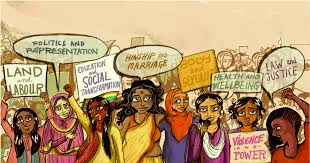
                                        picture: Women with raised hands image coutesy: EPW Feminism is the radical notion that women are...

Showing posts with label autonomy. Show all posts

Monday, 9 January 2017

Are Families Above Women?


Recently the Hindustan Times published a piece by Shashi Shekhar called Modern Families: Let's Keep Our Loved Ones Close.
Some aspects of the piece were quite bothersome and while attempting to decode it, I present my point of view here.

let's scratch the surface and take a look: what does the glorification of the family mean and who does it benefit?

The traditional definition of the family is: two or more people living together, related by birth, marriage or adoption. As members of a unit, they are supposed to support each other, in their general pursuit of a life of dignity. What if the unit turned against one of its own? 

Let us remember that historically, women were bound into the heterosexual, monogamous family to further the rights of men over their property, so they could be certain that the property they passed on, went only to their own offspring. Men leaned on the assurance of monogamy to ascertain that the child he called his own, was indeed his. The family has evolved to harness women's productive and reproductive labour for the benefit of the family and the man at its helm.


In the Indian context, the family has served as the basic unit of caste. Endogamy is the device used to ensure the perpetuation of caste. Endogamy or marriage within the same caste (while prohibited within certain kinship i.e. gotra) keeps the caste system thriving. A prerequisite for this is ensuring the virginity of the girl being given in marriage and even now in the year 2016. You need only glance at the matrimonial adverts in national newspaper to ascertain this. You'd be forgiven were you to think that you'd been transported bak in time. Certainly nothing gives away the fact that you're in 2016.


The normative heterosexual family is the unit of the state and it has been well established that the modern state functions in the image of the family. The power structure of the family is replicated at the state level and the sate defends the existence of the family and safeguards its interests.


Parsing through data collected by government agencies like National Crime Records Bureau (NCRB), we find that among all registered cases of violence against women, the largest share was cruelty by husband and relatives. Women are most at risk with their own families. The safe haven that is the family, is certainly a mirage as far as countless married women are concerned.


Large numbers of women are are kidnapped every year and forcing a woman into marriage continues to be the chief reason to kidnap her. As per NCRB data, just last year, in 2015, close to 54% of all abductions of women were carried out to force them into marriage. 


The report also says that police sources said much high numbers of kidnapping are probably due to the fact that parents of girls who eloped for marriage often registered cases of kidnapping against the man the girl eloped with. That's the loving family for you, which refuses to accept a woman's right to choose her own life partner. The unmarried woman is unsafe with her own family.


When harassed for dowry, a woman is left to her own devices, often facing torture and cruelty not just at the hands of husband but also her in-laws. Parents usually tend to have used up every resource on organizing the wedding, hence a return to the natal home is out of the question for most women. Often, women don't survive the torture and are either killed or commit suicide. 

Over the last three years, 24,771 dowry deaths reported which translates to roughly one dead woman every hour and that is just according to the government statistics. We know that the number of case reported are only a fraction of the real numbers. 

While the writer pines for the elusive happy family, all this freely available data makes not a dent in the carefully constructed halo around the sacred entity.


Let us look at a few of the statements made in the piece.

1. "The police suspect that even after coming out of prison, they wouldn't desist from such activities."
This reference is to youth who commit crime and have been to prison. If our concern is to have them desist from crime, they must be provided with appropriate tools,  such as counseling, set up with alternatives for a job, and everything else required for their rehabilitation should be provided. 


2. "Even our law enforcement authorities find themselves helpless when it comes to bringing misguided youth back into the mainstream." 
This is what happens when we confuse the job of one person with another. The police aren't counsellors or psychologists. 

3. "The rapid pace at which India's family traditions are breaking down, also has sociologists worried."

Really? I thought change was the only constant and societies and their structures have always changed and will continue to do so.

4. "Here we shouldn’t forget that Kerala, Karnataka and Maharashtra have higher literacy levels than other states in the country. But that doesn’t seem to have an effect on the incidence of disputes within families." 
The higher number of disputes in educated families indicate only one thing: women are asserting themselves. With education and a paying job comes economic independence and this helps women to assert themselves. They may have a greater say in how their families are run, specially economic ones. Having become contributors to the home economy in different ways, they may also take part in the decision making. Is that so terrible? 

5. "The Hindi heartland might compete with these states in the spheres of industrialisation, per capita income or literacy but they are not too far behind in cases of marital discord."

No sir, a woman asserting herself, her individuality, to gain economic independence or just to live life in her own terms, is not bringing about "marital discord". The traditional marriage, is set up in such a way as to be heavily loaded against women, and men have disproportionate power in the relationship.

That a mainstream media house would publish such an anti-woman drivel today is not surprising. To discuss the family without discussing the welfare of women who are its integral part, while blaming them for the dysfunction of the institution is myopic at best.


The piece clearly stresses family over women. This plays into the mindset that results in untold atrocities against women, across the country, everyday. It wouldn't be a stretch to assert that the family ordained murders of women called honour killings  and burning of brides for dowry and killing 2000 baby girls everyday  (usually female fetuses in the womb) are all extensions of the same mindset which stresses family over women. 


Traditions which dishonour a member of any group group need to be amended or, better still, discarded. It is time we looked up a new version of the family or like other endangered species it will also become extinct.  Good riddance, says my feminist heart. 


A version of this post appeared first on the website of  Feminism In India, here

Monday, 7 March 2016

Feminism

                                        picture: Women with raised hands image coutesy: EPW

Feminism is the radical notion that women are people said someone famous. That sums up feminism better than any long winded definition. Feminism aims to restore to women their full humanity, enabling us all to see women as human.


Here's the wikipedia entry and the dictionary definition of feminism. Yet time and again, we are fed the lie that feminism is anti-man or feminists want all men dead. (ahem! more on that later, when we talk about misandry) Most people simply don't know what feminism is, or have misconceptions about it. And so often it takes up a lot of feminists' time, effort and energy in explaining what it means. Here's my attempt at a sort of ready reckoner and myth buster. 


To quote bell hooks, "Simply put,  feminism is a movement to end sexism, sexist exploitation and oppression."


I will elaborate this in the Indian context- mostly the mainstream, north Indian one, which is most familiar to me. The parts that comprise the largest struggles of feminism in India are the patriarchy and the caste system, which combine and reinforce each other to make women's lives miserable.

Feminism aims at the restoration of basic human rights to women and people of all genders. This can only be achieved by dismantling the patriarchy, the system for and by men which keeps them in power through domination and violence. 


Let's talk about the patriarchy.

The head of the family is the patriarch or father. He is usually the oldest male member, in whom rests maximum power and who makes all decisions for the family. This power structure is replicated at all levels of society. The Indian state, too, is steeped in patriarchal attitudes, and through its various organs, sets out to decide for its citizens what is best for them. 
Patriarchy enforces strict gender roles for males and females.
                                                                   
 These roles are reinforced in a circular fashion.
It keeps men and women bound in certain roles, and as we perform these roles, we adapt to them. These performances of femininity and masculinity are closely monitored. There is praise on performing well and fierce retribution is meted out for missteps.Those who don't follow the norms face violent consequences and the cycle is perpetuated.


Women's performance of femininity are controlled through violence. And this cycle of violence perpetrated over centuries has become so ingrained in our social fabric, that we take it for granted.

Violence need not always be inflicted by a tear to the skin or a breaking of bones. A harsh word which hurts and may leave a lasting impact, or just the fear that something awful may happen to one is also violence. So often, just the threat of it is enough to keep women in control.

Moreover, women have so internalised the concepts of patriarchy and sexism that most of the time we don't recognise sexism when we see it. Misogyny isn't specific to men; women practise it freely too! Following the dictates of patriarchy can be rewarding to a certain extent. Women who toe the line are assured of a certain safety, specially if they belong to the upper caste or class- both usually reinforce each other in the Indian context.

One of the norms enforced by patriarchy are the labour roles designated by gender. Women are expected to stay at home, produce babies and look after the household chores such as cooking, cleaning, laundry and care of the old and infirm. Women are assumed to have a temperament which is best suited to such work. They are typecast into the roles of "natural born nurturers".

The flip side of this popular myth associated with gender roles is that men are best suited to the aggressive hustle and bustle of life outside the home and perform hard labour. Of course, these norms don't always stand up to scrutiny. But we are so conditioned to these norms, we accept them as they are, without question.


One only have to venture into the rural heartlands to see that in India today, the majority of the back breaking hard labour in agriculture is done by women: the majority of Indian farmers are women. But they are not termed farmers because the land they toil away on, either isn't to their names, or they work on others' fields and are thus not counted as labourers, not farmers.

The movement of feminism is more about erasing outdated gender roles rather than pitting two clearly demarcated groups against each others. Feminism aims to abolish these gender binaries and blur the lines.

Let's talk about the caste system.

As it stands today, caste is a system that confers on each person born into a Hindu family, an unalterable social status. There are four main castes but there are also those who are outside the fold, the "outcastes" or Dalits or untouchables.

Caste works as a "carefully graded system of inequality" arranged according to "an ascending order of reverence and descending order of contempt".


Caste can be more dehumanising than class as it deprives the disadvantaged of not only access to capital but also of dignity and personhood. Imagine a centuries old structure which simply doesn't recognise you; you're invisible to it.

Marriage is one of the key areas of life dominated by caste, and the endogamous marriage (within the same caste) is key to maintaining separations between castes. Maintaining the purity of the bloodline can only be achieved through keeping a tight control on women's bodies and their sexuality, which is also what patriarchy aims at: to keep women's sexuality in check.

The Caste System also helps uphold the Patriarchy.
The two systems of patriarchy and caste merge seamlessly and reinforce each other in exploiting the bodies of the marginalised and controlling the bodies of women.

Inequality operates at many levels in our society. Patriarchy also upholds the caste system and vice versa. The two systems in conjunction with each other keep many groups of people oppressed. Some of these groups like the people of all minority religions such as Muslims or indigenous tribes or adivasis are all marginalised, some of whom are at a double disadvantage.

The status of women belonging to these groups is even more inferrer to that of their menfolk. In the Indian context, feminism must look to include all such groups of the disenfranchised and provide them a platform. Feminism which doesn't include these groups is quite futile.

At the same time, in the broader context, women's postion in Indian society is much worse compared to men. Of course it's a matter of degrees: the lot of Indian upper class women -who are almost always also upper caste - is better than that of men of lower socio economic strata, who in turn are in a better position than their women folk, only if marginally so. Suffice it to say that though things may be getting better for women, we have a long struggle ahead in dismantling the patriarchy.

A look at some of the common myths around Feminism.

1. Feminism is a foreign import.

Feminism is very much an Indian product and has roots in India. In the modern context, men and women have been working for the emancipation of women from their unequal status since the nineteenth century.


One of the first to set up an all girls school and pave the way for women's education was Savitribai Phule, trailblazer in her own right.

2. Feminism seeks to make women equal to men. We aren't looking for equality, we are looking to dismantle the patriarchy (and the caste system must be annihilated along with it.)

Both these systems privilege some people by the accident of birth and condemns millions others to unforgivable and illegal forms of survival like manual scavenging, from which they have no respite. This is compounded by the fact that this system of injustice has been in place for centuries.Feminism seeks the liberation and freedom of all individuals, not just women.

3. Feminism is anti-men.

Feminism is anti-patriarchy and the system of violent coercion with which it works to enforce gender roles. Patriarchy and the caste system which it supports and underpins were built over centuries to put savarna or high caste men in privileged positions of power. These system were built by exploiting the bodies of women and men of lower castes.

Feminism doesn't advocate hatred of men. It aims at dismantling the system which is held up by men, mostly unwittingly and unthinkingly. Yes, the default beneficiary is men so it's no wonder it seems we are attacking men.

My suggestion for men: take a step back, don't make it personal. Don't assume you represent all men. And whether you like it or not, you are privileged; work to understand it. (hey, you're reading this piece, you're doing great! Yay!)

4. Feminism isn't needed anymore because women are already equal to men.

If you think women are equal now, and there is no need for feminism, you need to read some statistics. Girls are killed before birth and women are burnt for dowry. Women continue to be paid less on average than men, many jobs are not friendly to mothers, and women continue to be responsible for the majority of household work.

5. Women choose to doll up and be feminine, why do they need feminism?
Femininity is a performance women are forced into, yet they go gaga over spa treatments and hair colour? Yes, those acts may not be feminist acts in themselves but if wearing nail paint makes a woman happy, why shouldn't she? Also, we have to pick our battles till the day we all start dressing in a gender neutral, androgynous fashion. Till then, let's keep our bras and our toe rings.

6. Feminism only liberates women at the expense of men.
Feminism doesn't just liberate women; it also liberates men by breaking down the standards which society has put in place for both women and men. Men are taught in this society to be macho, emotionless leaders, and to never show weakness. "boys don't cry" is yet another stick to beat men into submission, by the patriarchy. Feminism says that it's okay for men to show weakness, be followers, and to show their emotions.

Feminism will set women and men free; free to achieve our full potentials as caring, loving, nurturing human beings. Because nothing less will do.


Note: I have used extensively my knowledge gleaned from reading bell hooks, and the books "gendering caste" by Uma Chakravarti, "The History of Patriarchy" by Gerda Lerner, and Dr. B.R. Ambedkar's writings. Deeply indebted to these. I have used open source images available from google.

Sunday, 3 January 2016

Pressing the Panic Button on Women's Autonomy


Ever since the horrific incident on 16 December 2012 in the bus in Delhi, several measures have been taken both by the governments at the centre and in the states, for the cause of women's safety. For example, the enactment of new laws based on the suggestions of Justice Verma Committee
Some of the fallout, however, may not have been beneficial to women.

For instance, the government of Delhi had promised a surfeit of surveillance cameras  on DTC buses and bus stands to intimidate attackers and deter crime against women and hopefully help bring the perpetrators to book.What remains unsaid in this intent, is who will police the police? experiments in other cities have shown that survelliance rarely acts as a deterrent. Instead, knowing how our law enforcement works, we should wonder if the invasion of the privacy of millions of women is worth the rare chance of catching culprits and deterring crime. 


There has also been a suggestion for a national women's helpline number. Most cities already have a functioning emergency helpline number so what purpose is a separate one, dedicated to women, expected to serve, isn't immediately clear. Where the additional resources required for this, such as manpower and gadgets, will come from, has not been clarified either.

It has recently been announced that mobile phone companies have agreed to install a panic button  and for women in distress, and that police help will soon be available with just a press of finger on their phone. 

There are two problems with this. How many Indian women own smart phones or even mobile phones, for that matter? Out of the total 612 million female population, only 28% own a mobile phone says this report in live mint. 

Secondly, what happens once the panic button is pressed? Sadly it doesn't connect us to a spanking new, efficient and empathetic criminal justice system. Response times is such situations are crucial. Not to forget, a perceived threat by the perpetrator may lead to further endangering the victim, rather than help her. 

As Rukmini Srinivas wrote in this piece in The Hindu,  on the rhetoric surrounding rape, that women are far more likely to be assaulted by a partner, husband or family member than by a stranger. However, seeing as marital rape is illegal and incest too incendiary a topic for discussion or debate, the days way out is to shift the discourse to stranger rape and harp on the attack on mostly upper class women by men of lower socio economic strata.

The Indian state has always been paternalistic in its attitude toward women, looking upon them as creatures needing protection, with no will of their own. The surveillance cameras and the panic buttons all fit in with this mindset of women being considered helpless creatures needing protection. 


Studies have repeatedly shown that well lit pedestrian areas, street hawkers, good urban design, frequent public transport, are the most effective deterrents for criminals. 


On the one hand, an efficiently conducted investigation, thorough trial and closing the entire process within a certain time frame would help further the cause of justice by bringing the perps to book. At the same time, centering the survivor or a sexual assault or rape, aiding her recovery, physically and psychologically, should be the aim of any civilised society. Both of these objectives can be met by one stop trauma centres.

 However, when it comes to such measures which would have the most impact this is how our government responds; by backtracking and cutting down on crucial infrastructure: just 36 of the 660 promised rape crisis centres are going to be built over the coming years.

Safety, it turns out, is yet another stick which can be used to beat women with. If anything the loud voices harping on "women's safety" on the one hand and only looking at gimmicky, myopic short term solutions, on the other are only working to further limit women's autonomy. With each cry of 'safety' t
he doors are locked more firmly in women's faces and the bolts fastened more surely than ever. 

(restricting this discussion to women but let's not forget the fact that non gender performing persons/LGBTQ folk are more likely than women to be attacked yet there seems no provision or talk about their safety) 

Monday, 2 February 2015

Women Only Spaces Limit Freedom

It's election time and once more women's safety is one of the issues being discussed, in the run up to theelections in Delhi. Happy news as it is to see women being given some importance at last - if only in party manifestos, with promises of protection. Of course, no political party is prepared to concede half
or even a third of its seats to women candidates. 

Once more the talk veers to "safety" the holy grail of a woman's existence. This talk conveniently ignores the fact that we live in a society underpinned by patriarchy, which celebrates and elevates machismo and toxic masculinity. This is the primary reason women are unsafe, and it is men from whom women need to be protected. 

The traditional wisdom of women's safety, usually centered around keeping certain women (upper caste) away from dangerous zones locked up at home has at least changed somewhat. We have not even begun talking about what goes on inside the home, where the vast majority of indian women report facing the most abuse and violence. About 6% to 60% percent women report facing domestic violence.

"Women only" spaces, are being suggested once again. Whether public spaces or in public transport, "women only" spaces are not the answer to all problems of women's safety. By limiting women's access to public spaces we not only pander to the fear psychosis but more importantly, limiting women's freedom we support the idea of women as fragile creatures needing protection in order to be safe. What about their liberty to be out and about, earning livelihoods, running errands, or if they so fancy, simply gallivant around town? 

Segregation based on gender only contributes to the impression that women are different, less able, fragile. A society where gender based segregation is the norm and boys are encouraged to see girls as different, 'the other' gender roles become even more entrenched by encouraging separate spaces for women in public too. 

Women do face assault in public spaces. Most women who must spend their lives in public are already stigmatised by the state in various ways. As most of these women happen to be "lower" caste women, their safety is not a concern of the state, apparently. Indeed the agents of the state like the police, or public officials run the gamut of harassing them, preventing them from going on with the basic business of survival. 

That a profusion of closed circuit televisions would enhance women's safety is not supported by research data either. It has been shown that CCTV is most effective when combined with other crime reducing methods such as improved lighting, security guards, and defensible space.  Why do the AAP people not think improving street lighting?

Women's agency and their privacy cannot be subsumed to surveillance. Do we trust such a large network of closely monitored surveillance in the hands of the government? Moreover at each step of the collection of this data there will be humans, mostly men involved. Who will guard them, and who's to ascertain there will be no breach of privacy of the women whose movements are being recorded. As this article states, when Delhi Metro CCTV footage leak was reported, people were more outrages that the couple were observed cosying up, rather than focus on the fact that their privacy had been breached! 
Would you feel safe knowing your every move was being tracked by a public eye ? Big brother is here; all hail Big Brother !