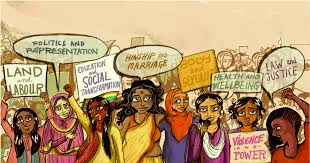
"The rapist is you!" Even as the chants of the flash mob in the video since gone viral, from Chile had a spill over effect, with many similar protests being organised and electrifying viewers the world over, we in India continued to see more and more cases of gender based violence fill up our front pages and airwaves.
"One is not born, but rather becomes, a woman."
The power relationships that exist within the contemporary gender landscape are hugely tilted in favour of men. Dominant ideals of manhood impact women and different ways of being men, as also those who fit neither category.
Historically, the male gender is naturalized as the universal.
Masculinity is the socially produced and embodied way of being male. It manifests itself in many ways such as manner of speech, behavior, gestures, social interactions, a division of tasks and a position of superiority to its perceived antithesis, femininity. Because masculinity is valorized, its consequences are many and varied not just for women but also those men who do not perform the dominant model of masculinity.
In order to stand in a relationship of superiority to the feminine, masculinity must be represented as the binary opposite of the feminine identity. Dominant masculinity has certain identifying characteristics. Embedded in these representations are an inventory of behaviors and roles that have been historically valorized as becoming of ideal masculinity. Discourses on sexual orientation i.e. heteronormativity, class, race and conjugality all lead to the manufacture of this dominant masculine identity.
Gender is produced historically and socially. Indeed the discourses around the production of the proper masculine behavior stem from the fact that masculinity is not naturally endowed. Masculinity must be constantly reinforced, hence, it's tenuous and fragile nature. Masculinity is enacted rather than expressed, as it is not something already inherently present.
PATRIARCHY
Patriarchy is the systemic relationship between men and women, placing men in a s superior position. It privileges all men. Masculinity produces superior men who are privileged over all women and lesser men. While there are strong cultural expectations that women will be chaste and obedient, no such expectations attach to men. Such a mentality and practices that stem from it result in oppression and exploitation of women. Women themselves tolerate and rationalize this subjugation and see it as natural.
In a most recent survey published by India Spend, a web based ortal while 65%Indian women are literate, only 5% have sole control over choosing their partner and 60% practice some or other form of fcae veiling or head covering.
Patriarchy is the systemic relationship between men and women, placing men in a s superior position. It privileges all men. Masculinity produces superior men who are privileged over all women and lesser men. While there are strong cultural expectations that women will be chaste and obedient, no such expectations attach to men. Such a mentality and practices that stem from it result in oppression and exploitation of women. Women themselves tolerate and rationalize this subjugation and see it as natural.
In a most recent survey published by India Spend, a web based ortal while 65%Indian women are literate, only 5% have sole control over choosing their partner and 60% practice some or other form of fcae veiling or head covering.
CASTE IN INDIA
We have to confront the fact that caste is another axis of oppression which women of "lower" castes face the brunt of every day. In fact it comes as no surprise that the majority of the violence that women face in India, are along caste lines.
Bhanwari Devi, a Dalit woman was raped by upper caste men of her village for simply doing her job, advocating against child marriage. Rape was used a s a tool to "show her her place" and subjugate her. However she continued to fight for justice and it was her struggle that lead to the very first guidelines was formulated to help prevent sexual harrassment faced by women in their workplace.

LAW
The law perpetuates gender hierarchy. It is tasked with the protection of women and this is manifested in paternalism as a form of safety.
The law perpetuates gender hierarchy. It is tasked with the protection of women and this is manifested in paternalism as a form of safety.
Right to property plays a crucial role in power imbalances within households. Devaluation of daughters as they are not entitled to land or other property leads to the difference in treatment of girls and boys from childhood. Women internalize these limiting characteristics, this lessening of their rights to everything from space, to education to nutrition and even medical care.
THE VIOLENCE OF THE DENIAL OF LIFE
The adverse sex ratio of females to males in India is a case in point. Recently the women and child welfare minister said that about 2000 girls are killed in India everyday. A girl is only seen as a burden. As her basic duty in life is to be a housewife and care giver and producer of babies, parents see her as a burden to carry till such time as she can be married off. The dowry that needs to be given as compensation to the man and his family poses further economic burden on the girl's family.
OBJECTIFICATION
THE VIOLENCE OF THE DENIAL OF LIFE
The adverse sex ratio of females to males in India is a case in point. Recently the women and child welfare minister said that about 2000 girls are killed in India everyday. A girl is only seen as a burden. As her basic duty in life is to be a housewife and care giver and producer of babies, parents see her as a burden to carry till such time as she can be married off. The dowry that needs to be given as compensation to the man and his family poses further economic burden on the girl's family.
OBJECTIFICATION
"Man is defined as a human being and a woman as a female — whenever she behaves as a human being she is said to imitate the male."
— Simone de Beauvoir
— Simone de Beauvoir
The body of a man makes sense in itself quite apart from that of women, whereas the latter seems wanting in significance by itself. She appears in essence to the male as a sexual being. Othering of woman is centuries old, and with mothering comes treatment of being sub human. With the institutionalizations of the other, woman cannot be equal.
Martha Nussbaum has identified the seven different ways in which objectification works:
- instrumentality
- denial of autonomy
- inertness
- fungibility
- violability
- denial of subjectivity.
COMMODIFICATION
“The body is the instrument of our hold on the world.”
― Simone de Beauvoir, The Second Sex.
The body as our instrument in the world is completely available to men. Boys are encouraged to explore the world, step out into it and have far greater control over their bodies. Women have little control specially in a hierarchical society like India. Girls are indoctrinated into thinking of themselves as less and they also self - identify in a sexualized way, so they may mould themselves into an version appealing to men.
The ease of commodification of women has increased with globalization. Easy access to TV and phones which help sell women and their sexuality in various ways. There were recent reports that men would rape women and film the act. These videos would then be easily available fir as little as 50 rupees in the market. Easy dissemination of such videos via multimedia messaging has made access to such images of the commodification of women and their bodies.
The personal and intellectual capacities of women are denied, and the woman spoken of as a body only, or even just a body part. In prostitution no woman stays whole, and certainly not human. The dehumanization and dismemberment of the female body is necessary in prostitution. Pornography is media and image based prostitution where again women's bodies are commodified. Sexualization and commodification are two sides of the same coin.
THE BEAUTY INDUSTRY
This is yet another product of the sexualization of women's bodies driven by large multinational corporates and advertising conglomerates which form the nexus which drive the huge beauty industry, comprising of cosmetics and body image changing such as cosmetic surgery and of course fashion and garment industries. The time when we would clothe ourselves for protection are far behind us.
This is yet another product of the sexualization of women's bodies driven by large multinational corporates and advertising conglomerates which form the nexus which drive the huge beauty industry, comprising of cosmetics and body image changing such as cosmetic surgery and of course fashion and garment industries. The time when we would clothe ourselves for protection are far behind us.
POWER
The meaning of being a man or woman and notions of manhood and womanhood may vary but masculine identity is usually associated with experiences and assertion of power. Paternalistic cultural models encourage the view that men protect women from harm, thus giving the impression that women are incapable of protecting themselves.
SEXUAL VIOLENCE
Incidents of sexual violence involve elements of control, power, domination, and humiliation. In order to gain power and control over their victims, perpetrators of sexual violence resort to practices such as abduction, isolation, manipulation, coercion, threats, and sexual abuse.
While men may not necessarily find the act sexually gratifying but the sense of power may override other considerations. If a woman resists sex, it may be perceived as a threat to a man's masculinity. Such a crisis of male identity may contribute to sexual violence. It has been reported that victims who attempt resistance or escape from the situation are more likely to be brutalized by the offender, giving an inflated sense of power to the abuser.
While men may not necessarily find the act sexually gratifying but the sense of power may override other considerations. If a woman resists sex, it may be perceived as a threat to a man's masculinity. Such a crisis of male identity may contribute to sexual violence. It has been reported that victims who attempt resistance or escape from the situation are more likely to be brutalized by the offender, giving an inflated sense of power to the abuser.
In patriarchal cultures, any resistance from the woman is perceived as an insult to his manhood further provoking him to resort to more violent means to control the victim.
Rape is seen as a tool of a dominance. Societal attitudes toward women may help condone rape. Such stereotypes are often internalized from the male dominated culture at large.
Sexual violence results from a misogynist attitude prevalent in our culture. Indian girls and women have no independent control of their sexuality. They are expected to get married and produce children, thus shifting the control of their sexuality from one man to the other.
Till the burden of being sub-humans carries on, no woman will be free from violence.