Feminism

Feminism

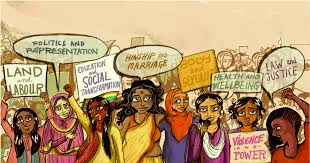
                                        picture: Women with raised hands image coutesy: EPW Feminism is the radical notion that women are...

Showing posts with label sexism. Show all posts

Thursday, 1 September 2016

Making A (Feminist?) Choice


Now that "women's empowerment" is all the rage and women seem to have acquired a booming voice and our choice  is suddenly everywhere. Since having our voices silenced has been the default state for women, it seems all the more novel.

Come to think of it, is this hurrah really for us, or are we being used as stepping stones for big corporations to get ahead while they push us further back into misogynist territory? Like a magician performing a sleight of hand, here's the elaborate illusion that we are the winners- but does it hold up to scrutiny?


As we go about our life struggles, we are constantly forced to make choices. Each choice comes with its own consequences, some positive and some not so much. 
Not all choices are easy, but every choice is made after weighing all the factors. We try to do the best we can, under the circumstances, based on what we know at the time. 

These choices may vary, and even for the same woman, change depending on the circumstances. 
Consider a woman who gets paid to work outside the home, but if she's from an upper caste/class family she has to quit after child birth because child care is assumed to be her primary responsibility. Surely, no woman wants to end up paying the mommy penalty out of choice? 

It's no secret that sexism flourishes in the marketplace, limiting our choices, while making the opposite appear true. What choices do women and non binary persons really have?

The much touted "choice feminism" is nothing but a self indulgent narcissistic idea that every act of choice made by a woman, is an inherently feminist act. Simply the act of choosing empowers us-that is, of course, utter horseshit.

Choice feminism is all about making these choices sound like they are revolutionary, no matter how far they push us back into the 15th century, simply by virtue of having been made by a woman. 


For example, the choice to whiten your vagina- is that feminist act too? If your whiter vagina raises your self esteem or helps give you pleasure, please go right ahead and do it- but please don't claim it as an inherently feminist act, simply by virtue of having made a choice. 

Another facet of our lives where choice constantly rears its head, is that of the daily rituals surrounding our appearance. Femininity is a performance, and the best performers are richly rewarded for their efforts. Attire and grooming are big components of performing femininity.

 The little dab of kohl that I apply to my eyes each morning and the touch of lipstick which never lasts through the day- I do it because I like the appearance, it makes me feel pretty. What's pretty? My notions of beauty are those which I've grown up with. Many of these inherited notions I've outgrown, and of course I've acquired some of my own as I've aged. 

But also, I've learnt the idea that to be professional is to be well groomed. The line between grooming and femininity are blurry indeed. Isn't having a "well-groomed, professional" look also a performance of femininity?  

All the current "women's" magazines will tell you that you need separate sets of clothes for work. Where does fashion end and professionalism begin? By telling us what is in and what's not- staging an ever burgeoning line of all kinds of wear, fashion only serves to hem us in. 

Who's to say that I can't wear the same saree to work and go shopping in it and enter the kitchen in the same, to cook? I'm sure our grandmothers did it and the multitudes of women toiling away in the fields do to this day. As much as the fashion purports to provide us with choices, in reality it limits us, it ties us down. 

Not only are we sexist, we are also an ageist society. The elderly and greying are judged as being less active, less able to perform efficiently. Much as I'd like to let my hair go grey, I'm not yet ready for the judgement that I'm sure will follow at my workplace. So I dye my hair, and look the better for it, too. 

Let me confess, going grey is not going to be an easy decision. Thick, glossy, colored hair is not only youthful-read energetic- it also looks pretty. Hand on my heart, I'm not ready to face my dowdy self-not yet. In my own eyes I look more feminine, and it coincides better with the constant barrage of media images of what it means to be pretty.  

I wear some make up, I follow a dress code, and I color my hair. I follow these dictats, for what it means to be a well groomed professional. Because the choice I make, is to keep working my job, while not sticking out like a sore thumb at my work place. Those choices are not feminist acts by any stretch. 

 Does feminism take a backseat to living an even-keeled life? You bet. Is my every act a well thought out act of feminism? No, far from it. Does it make me a less passionate feminist? Probably. I don't think know. We'll find out when we have the feminist-meter in our hands. Or maybe some enterprising soul has already manufactured and patented it, who knows? Personally I know I must pick my battles. I try and go about them as astutely as possible.

The sexism rife in the world continues unabated and it's a constant struggle to balance out the demands to be feminist. To contribute with each act to the bending of gender norms too is in all probability not going to happen all the time. It is a heavy a burden to carry. Rest, till your shoulders allow you. 


Monday, 7 March 2016

Feminism

                                        picture: Women with raised hands image coutesy: EPW

Feminism is the radical notion that women are people said someone famous. That sums up feminism better than any long winded definition. Feminism aims to restore to women their full humanity, enabling us all to see women as human.


Here's the wikipedia entry and the dictionary definition of feminism. Yet time and again, we are fed the lie that feminism is anti-man or feminists want all men dead. (ahem! more on that later, when we talk about misandry) Most people simply don't know what feminism is, or have misconceptions about it. And so often it takes up a lot of feminists' time, effort and energy in explaining what it means. Here's my attempt at a sort of ready reckoner and myth buster. 


To quote bell hooks, "Simply put,  feminism is a movement to end sexism, sexist exploitation and oppression."


I will elaborate this in the Indian context- mostly the mainstream, north Indian one, which is most familiar to me. The parts that comprise the largest struggles of feminism in India are the patriarchy and the caste system, which combine and reinforce each other to make women's lives miserable.

Feminism aims at the restoration of basic human rights to women and people of all genders. This can only be achieved by dismantling the patriarchy, the system for and by men which keeps them in power through domination and violence. 


Let's talk about the patriarchy.

The head of the family is the patriarch or father. He is usually the oldest male member, in whom rests maximum power and who makes all decisions for the family. This power structure is replicated at all levels of society. The Indian state, too, is steeped in patriarchal attitudes, and through its various organs, sets out to decide for its citizens what is best for them. 
Patriarchy enforces strict gender roles for males and females.
                                                                   
 These roles are reinforced in a circular fashion.
It keeps men and women bound in certain roles, and as we perform these roles, we adapt to them. These performances of femininity and masculinity are closely monitored. There is praise on performing well and fierce retribution is meted out for missteps.Those who don't follow the norms face violent consequences and the cycle is perpetuated.


Women's performance of femininity are controlled through violence. And this cycle of violence perpetrated over centuries has become so ingrained in our social fabric, that we take it for granted.

Violence need not always be inflicted by a tear to the skin or a breaking of bones. A harsh word which hurts and may leave a lasting impact, or just the fear that something awful may happen to one is also violence. So often, just the threat of it is enough to keep women in control.

Moreover, women have so internalised the concepts of patriarchy and sexism that most of the time we don't recognise sexism when we see it. Misogyny isn't specific to men; women practise it freely too! Following the dictates of patriarchy can be rewarding to a certain extent. Women who toe the line are assured of a certain safety, specially if they belong to the upper caste or class- both usually reinforce each other in the Indian context.

One of the norms enforced by patriarchy are the labour roles designated by gender. Women are expected to stay at home, produce babies and look after the household chores such as cooking, cleaning, laundry and care of the old and infirm. Women are assumed to have a temperament which is best suited to such work. They are typecast into the roles of "natural born nurturers".

The flip side of this popular myth associated with gender roles is that men are best suited to the aggressive hustle and bustle of life outside the home and perform hard labour. Of course, these norms don't always stand up to scrutiny. But we are so conditioned to these norms, we accept them as they are, without question.


One only have to venture into the rural heartlands to see that in India today, the majority of the back breaking hard labour in agriculture is done by women: the majority of Indian farmers are women. But they are not termed farmers because the land they toil away on, either isn't to their names, or they work on others' fields and are thus not counted as labourers, not farmers.

The movement of feminism is more about erasing outdated gender roles rather than pitting two clearly demarcated groups against each others. Feminism aims to abolish these gender binaries and blur the lines.

Let's talk about the caste system.

As it stands today, caste is a system that confers on each person born into a Hindu family, an unalterable social status. There are four main castes but there are also those who are outside the fold, the "outcastes" or Dalits or untouchables.

Caste works as a "carefully graded system of inequality" arranged according to "an ascending order of reverence and descending order of contempt".


Caste can be more dehumanising than class as it deprives the disadvantaged of not only access to capital but also of dignity and personhood. Imagine a centuries old structure which simply doesn't recognise you; you're invisible to it.

Marriage is one of the key areas of life dominated by caste, and the endogamous marriage (within the same caste) is key to maintaining separations between castes. Maintaining the purity of the bloodline can only be achieved through keeping a tight control on women's bodies and their sexuality, which is also what patriarchy aims at: to keep women's sexuality in check.

The Caste System also helps uphold the Patriarchy.
The two systems of patriarchy and caste merge seamlessly and reinforce each other in exploiting the bodies of the marginalised and controlling the bodies of women.

Inequality operates at many levels in our society. Patriarchy also upholds the caste system and vice versa. The two systems in conjunction with each other keep many groups of people oppressed. Some of these groups like the people of all minority religions such as Muslims or indigenous tribes or adivasis are all marginalised, some of whom are at a double disadvantage.

The status of women belonging to these groups is even more inferrer to that of their menfolk. In the Indian context, feminism must look to include all such groups of the disenfranchised and provide them a platform. Feminism which doesn't include these groups is quite futile.

At the same time, in the broader context, women's postion in Indian society is much worse compared to men. Of course it's a matter of degrees: the lot of Indian upper class women -who are almost always also upper caste - is better than that of men of lower socio economic strata, who in turn are in a better position than their women folk, only if marginally so. Suffice it to say that though things may be getting better for women, we have a long struggle ahead in dismantling the patriarchy.

A look at some of the common myths around Feminism.

1. Feminism is a foreign import.

Feminism is very much an Indian product and has roots in India. In the modern context, men and women have been working for the emancipation of women from their unequal status since the nineteenth century.


One of the first to set up an all girls school and pave the way for women's education was Savitribai Phule, trailblazer in her own right.

2. Feminism seeks to make women equal to men. We aren't looking for equality, we are looking to dismantle the patriarchy (and the caste system must be annihilated along with it.)

Both these systems privilege some people by the accident of birth and condemns millions others to unforgivable and illegal forms of survival like manual scavenging, from which they have no respite. This is compounded by the fact that this system of injustice has been in place for centuries.Feminism seeks the liberation and freedom of all individuals, not just women.

3. Feminism is anti-men.

Feminism is anti-patriarchy and the system of violent coercion with which it works to enforce gender roles. Patriarchy and the caste system which it supports and underpins were built over centuries to put savarna or high caste men in privileged positions of power. These system were built by exploiting the bodies of women and men of lower castes.

Feminism doesn't advocate hatred of men. It aims at dismantling the system which is held up by men, mostly unwittingly and unthinkingly. Yes, the default beneficiary is men so it's no wonder it seems we are attacking men.

My suggestion for men: take a step back, don't make it personal. Don't assume you represent all men. And whether you like it or not, you are privileged; work to understand it. (hey, you're reading this piece, you're doing great! Yay!)

4. Feminism isn't needed anymore because women are already equal to men.

If you think women are equal now, and there is no need for feminism, you need to read some statistics. Girls are killed before birth and women are burnt for dowry. Women continue to be paid less on average than men, many jobs are not friendly to mothers, and women continue to be responsible for the majority of household work.

5. Women choose to doll up and be feminine, why do they need feminism?
Femininity is a performance women are forced into, yet they go gaga over spa treatments and hair colour? Yes, those acts may not be feminist acts in themselves but if wearing nail paint makes a woman happy, why shouldn't she? Also, we have to pick our battles till the day we all start dressing in a gender neutral, androgynous fashion. Till then, let's keep our bras and our toe rings.

6. Feminism only liberates women at the expense of men.
Feminism doesn't just liberate women; it also liberates men by breaking down the standards which society has put in place for both women and men. Men are taught in this society to be macho, emotionless leaders, and to never show weakness. "boys don't cry" is yet another stick to beat men into submission, by the patriarchy. Feminism says that it's okay for men to show weakness, be followers, and to show their emotions.

Feminism will set women and men free; free to achieve our full potentials as caring, loving, nurturing human beings. Because nothing less will do.


Note: I have used extensively my knowledge gleaned from reading bell hooks, and the books "gendering caste" by Uma Chakravarti, "The History of Patriarchy" by Gerda Lerner, and Dr. B.R. Ambedkar's writings. Deeply indebted to these. I have used open source images available from google.

Sunday, 27 December 2015

Caregiving and Paid Work


How often have you heard the argument that women would be better off, and the cause of their empowerment greatly furthered, only if they worked? Even the most well meaning women and often men -read privileged, and blinded by it- will say it with all the emphasis at their disposal. Implicit in the statement, is the assumption that women normally don't "work"!
                                                   Picture: image courtesy UN WOMEN
                               
Going outside the home to work, and being compensated monetarily for that work, is quite a recent development in human history. The idea of work outside the home, monetised, is less then a hundred and fifty odd years old.  

So much of our lives are determined by money- the having of it, the ability to spend it and save it. - the consequence that if you don't have enough of it, or don't earn it at all, you are not worth much, is only to be expected.

 Since the work such as cooking, cleaning, washing, care giving, child rearing and care of the elderly and the infirm, generally considered women's work is not valued monetarily, it's fallout is the undervaluing of women's lives. Proof, if it were needed, is in this piece in Huffingtonpost India  saying that Indian women do ten times the unpaid work that men do.

One is likely to think, at this juncture, what's to stop a woman from going out to work? Many women are doing just that. But when it comes to women it all gets massively complicated. Because uterus, eggs, new humans. 

Having babies and furthering one's family- and the human race, by extension- would logically seem to be in the interests of men, too; a father is, after all, as much a parent as a mother. Yet the structures of patriarchy have been so constructed that over centuries, childcare and nurturing has been relegated to women and now they are deemed to be specialists at the job. A job that keeps them at home, unpaid and undervalued. 

If you read women's magazines you may be familiar with that rare beast, the "work-life balance". This struggle is restricted to a very small segment of the Indian population, women born into privilege, who were afforded an education and then could exercise the option to pursue a career. Yet many of these women had to opt out of flourishing and highly successful careers, specially when they had their children, as told in this recent story in Quartz. Like I said, uterus, eggs, new humans. 

Needless to say, men need make no such attempt at balance because the life part is well taken care of for them and they are free to look into their careers with single minded focus. If they do pitch in with care work, they earn extra brownie points for it. Women, on the other hand, even when earning an income outside the home, are saddled with child rearing and care giving. Men are encouraged and expected to seek partners with less earning capacity than themselves for this reason.

There's a website with pretences to feminism which goes by the tagline: "for women who do". Left unnamed, presumably, is the category of the millions of women who don't.  Of course, house work doesn't count as work. When the media does centre women, it talks to them condescendingly.

Not unsurprisingly,when the talk does veer to getting women into paying jobs the purpose is to boost the economy. Here's an example from CNBC.com that says why women should be allowed to do more paid work as it could be a huge boost to the economy. So even when there is an acknowledgement that a woman can't just up and walk out of her home into a job, no thought seems to be given to look into the hurdles in the way. The economy is centred, not the woman.

In summing up :
1. Large numbers of educated women stay home or give up jobs once they get married or especially once they have babies.
2. Women who were working outside the home, but cease to do so after marriage, do so either because their husbands or in-laws will not allow them as it's beneath their dignity or because the jobs available aren't well paying enough.
3. Women stop working outside the home after childbirth due to lack of proper child care facilities.

A few suggestions.
1. Give monetary support to mothers or other care givers. A fixed amount, per child or elder who needs full time care. This will add value to the care giving work, while making the obtaining of the supplies needed for taking care of the child or elderly. 
2. Encourage employers to provide child care facilities to their employees. 
3. Paternity leave should be extended and made mandatory. Child rearing should be as much a man's job as a woman's if you really wanted to bring the child into the world.
4. We could tie this up with added incentives for parents having a girl child. This kind of a gesture could also be of great symbolic value. Let's not forget that we have an abysmal sex ratio at birth. 

Post script: Only 933 girls are born for every 1000 boys in India as per the Government of India 2011 Census. The causes of that and its repercussions are a matter for another discussion, another day.